
Blog / Hatfield Scion Service

Blog

All Hatfield Scion Service Hatfield Scion Dealer Toyota Models Vehicle Tips Peruzzi Toyota News Toyota News Hatfield Toyota Dealer Peruzzi Toyota Service Driving Tips Toyota Technology Hatfield Used Cars Safety Tips Electric Vehicles Peruzzi Toyota Accessories Peruzzi Toyota Parts Safety Tops Toyota Financing

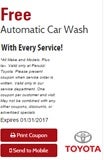
Get a Free Automatic Car Wash With Each Peruzzi Toyota Service!

From now until January 2017, every time you bring your vehicle into our Hatfield PA Toyota service center, it will receive a free automatic car wash. Not only will this be a good way to keep your vehicle regularly maintained, our well trained staff will ensure the exterior is clean and protected from the elements. Grime Build-Up Can Hurt Driving on the road, especially during winter weather conditions, can mean your car is subjected to hazards which are dangerous to the finish. Grime, oil, and road salt are all common elements on the road which cling to the car and eventually could eat away at the finish and the underside. By removing this grime and debris on a regular basis, you can keep your finish in like new condition and cut down on damage over the long run. A Professional Clean Helps Many owners choose to clean their car on their own to save money. However, missing areas or not using the right products can do more harm than good. Having our Toyota team take care of the cleaning process will mean more dirt and build up is removed. It also means you won’t have to work as hard to keep your car clean. Print out the Free Cash Wash coupon on our website and bring it with you on your next visit. If it’s been some time since you’ve had your car to our service center for maintenance, take advantage of our car wash offer at no additional cost and let our technicians inspect and maintain your car properly.
engine-repair

Peruzzi Toyota Now Offering a Free Multi-Point Inspection

From now until December 31, 2016, the service center staff at our Hatfield Toyota service center will provide a free multi-point inspection. We welcome all makes and models to our service center. Our certified service technicians will conduct a thorough evaluation of your vehicle to ensure it is safe for the road. The multi-point inspection includes: Tire check – inspect for signs of wear and damage including bulges, punctures, and ensure proper tire tread depth. System check – inspection of the suspension system, brake hydraulic system, and exhaust system. Brake pads – inspection of brake pads and rotors for signs of wear, including front, rear, and parking brake. Clutch – check for proper operation and necessary adjustments. Leak check – inspection of engine and transmission for leaks. Belt/hoses – inspection of the condition of belts, radiator hoses, and battery cables. Lights – check the functionality of exterior and interior lighting systems. After the initial inspection, our technicians will take your vehicle out for a road test and provide a report on its performance during operation. Recommendations for repairs will be made which can also be completed by our Toyota technicians. A printable coupon can be downloaded from our website. You can also send the coupon to your mobile phone and present it at the time of service. Schedule your free multi-point inspection today and get your car ready for the road. Routine maintenance services including oil changes and fluid checks can also be done at the same time to protect your car’s engine and other systems.

Summer Road Trip Safety Tips from the Hatfield Toyota Crew

It is that time of year again; road trip season. Here at your local Hatfield Toyota dealership, we want to give you some helpful insights about how best to make any upcoming road trips your family embarks on into cherished memories. Much of this is accomplished through proper preparation and careful planning ahead of time. Plan Ahead: With google maps it is easy to sit down and identify potential routes and travel times. If you have small children, you will likely want to travel intentionally, picking rest areas and towns to stop over in for potty breaks and burn off any excess energy built up through a couple hours of sitting. Sprinkle your trip with fun stopovers and remember, road trips are as much about the journey as the destination. Food, Food, Food: Road tripping is all about sharing snacks, picnics and eating on the run. If you are road tripping on a budget, you’ll want to pre-make your food. Carrots, berries, grapes, and crackers make excellent healthy snacks that won’t break the bank. You may want to pre-portion these with younger children to avoid squabbles over who gets how much. Accident Prevention and Safety: Last, but certainly not least, you’ll want to get your car checked out to ensure that the hoses and belts are all in good condition and check that the oil and tires are in excellent condition prior to embarking upon your summer adventures. Finally, if you are traveling with small children, be certain to ensure that they have the appropriate child car seat. You can get your Toyota inspected free of charge here at the Hatfield Toyota dealership and we’ll ensure that your car’s performance offers your family the opportunity to enjoy the road trip.

Pennsylvania Toyota Dealership Explains the Most Important Safety Features

With all of the innovations over just the last few years, cars have gone far beyond just seatbelts and airbags. In fact, today’s cars are safer than ever largely because of computers and automated systems running throughout your car. Your Pennsylvania Toyota dealership talks you through the most essential safety equipment. Seatbelts The most essential of all safety features, the humble seatbelt is credited with saving hundreds of thousands of lives every year. The triple-anchored seatbelt is being looked at by several companies for improvements, but that’s a long way off. Airbags One of the most changed pieces of safety equipment, the airbag has been given quite a makeover. Intelligent airbags use sensors in the seat and the engine in order to detect the size, weight, and even posture of a passenger and adapt the deployment pressure accordingly. Dual-stage or multi-stage airbags do something similar. These deploy once for central impact and again for residual impact. Add to this curtain, side, knee, and even seatbelt airbags, and you’re safer than you’ve ever been. Area Alerts Along with sensors in the car are sensors around the car. Radar and laser detectors can tell you when someone is in your blindspot, when someone is about to cut you off, and when a front collision is about to happen, even if you can’t see it. These alerts are incredibly useful and have drastically decreased accidents. Automated Stopping The most recent addition is a system that applies brakes before you can when one of those alerts is triggered. This can mean a rear or frontal collision, but what’s more impressive is that cars armed with these kinds of systems have reached zero fatalities.

100_0902

Hatfield Toyota Offers Tips for Driving at High Altitudes

If you have plans to head north to the mountains, know that driving in higher altitudes is a little trickier than what you are used to at lower ground. Not only do you have to contend with different weather patterns and environment, but also you have to be aware of windy roads, animals and falling rocks. If you are headed to the mountains, Hatfield Toyota offers tips for driving in the mountains. Before you Leave Before you head up to the mountains, take care of a few items of business first. Take the car in for regular maintenance and inspection Fill up the vehicle Pack plenty of fluids for you and your vehicle Pack a high-altitude care kit Health Problems Associated with High Altitudes When you are at high altitudes, you can run into a number of health issues. Dry air If you are susceptible to nose bleeds in dry climates, take a nasal spray with you to prevent dry nasal membranes. Dry air can also cause dry eyes, so pack artificial tears or contacts drops. Altitude sickness Before you leave, talk to your doctor about medications to combat altitude sickness. Symptoms of altitude sickness can arise within 72 hours of arriving. Symptoms include fatigue, sleep issues, nausea, no appetite, headache, and shortness of breath. If you experience any of the symptoms, seek medical help. Motion sickness Motion sickness is common when driving in high altitudes. Consider packing an over-the-counter motion sickness medication and disposable bags if an emergency arises. Tips for Driving When you are driving in the mountains, adjust your driving habits to keep you and your passengers safe. Watch for pedestrians, bikers, and animals on the side of the road Do not coast downhill Use low gears to climb and descend Slow down on winding roads, around curves, and when cornering Avoid using the AC if you are concerned about overheating Don’t ride your brakes when going down hill

engine-repair

Pennsylvania Area Toyota Discusses Power Steering Recall

Your local Peruzzi dealership can help you understand and remedy recalls. In March Toyota announced it would be recalling over 110,000 Toyota sedan and SUVs models. If you want to know more about the recall, your trusted dealership professionals can help you out. Pennsylvania area Toyota service team discusses the recent power steering recall. Which Vehicles are Affected? According to the March announcement from Toyota, the company is recalling the following vehicles: 2015 Camry sedans and hybrid versions sedans 2015 Highlander SUVs and hybrid versions 2014-2015 RAV4 SUVs What is the Issue? The affected models may have faulty circuit boards that can shut power steering to the vehicles. The vehicle will revert to manual steering only, which can make it difficult to steer the vehicle, especially at low speeds. The company will replace the steering system’s electronic control unit. Is My Vehicle Recalled? Consumers who are concerned about the recent recall can call Toyota or the NHTSA. As of March 15, 2015, the NHTSA had not yet posted all of the complete recall filings. Consumers affected by the power steering recall will be notified by Toyota via US mail. The recall letter will identify the problem, the affected vehicles, and the remedy. The letter requests consumers contact the dealership for an immediate repair, free of charge. If you are still concerned, you can make a few phone calls or hit the web. Contact Toyota customer service or the dealership directly to inquire about the recent recall announcement Visit safercar.gov to look up recall information for your specific vehicle. You can research by year, make and mode, or you can input your vehicle’s VIN.

dirty carpeting

Hatfield Toyota Discusses “Wear and Tear”

If you look at your owner’s manual, the term ‘wear and tear’ pops up a few times. Wear and tear affects leasing, trade-in value, tire warranties and replacement, and warranty coverage, so it is a good idea to understand it fully. Naturally, vehicles are going to experience a degree of wear, but when does it become a problem? Hatfield Toyota discusses wear and tear. Determining Wear and Use Toyota Financial has a table to assist leasing consumers with evaluating normal and excessive use of a vehicle. The following list includes examples of excessive wear. Any damage to the seats or trim larger than a credit card, and multiple damaged locations Missing parts and/or accessories Any modifications or improperly installed equipment personally installed or at another location that is not the dealership Body scratches larger than the size of a credit card Scratched/dented bumper(s) Bald or damaged tires Damage or missing wheels Broken or damaged glass surfaces and accessories Scratched body panels Poor body work Damage to factory tint or installed aftermarket tint Missing/damaged mirrors, lamps, or signals What are the Consequences of Excessive Wear? Excessive wear and tear will present a number of issues when you visit the dealership. Reduces car’s trade-in value Increases the number of service and maintenance trips you will have to pay for May affect certain warranty coverages Leasing company will charge for excessive wear, damage to the vehicle, and aftermarket modifications The dealership team will ultimately be the ones determining wear and tear. The above table gives you insight into the process.

inspection

Pennsylvania Toyota Dealership Warns Against Unnecessary Cures

If you have your vehicle serviced at somewhere other than the dealership, you may have noticed that some of the services differ greatly from those at the dealer. Is there really a miracle cure to increase your fuel economy ratings, make your car run cleaner and last longer? If you aren’t sure, take a look at your owner’s manual or call the service department. Pennsylvania Toyota dealership warns against unnecessary car cures. Fuel injector cleaners If someone is not taking your fuel injectors out of the engine and physically cleaning them, a pricey bottle of goo is not going to do a darn thing. Engine flushes You won’t find the term ‘engine flush’ in your owner’s manual. Most cars don’t need an engine flush, especially if the driver remains up-to-date on recommended service and maintenance. New brakes and pads If you take your car in for brake inspection and service, be careful the shop doesn’t try to charge you for a complete brake overhaul. Look at the owner’s manual service schedule, listen to your brakes, and pay attention to how your car handles. If a complete brake job seems a little premature, it probably is. Labor costs for state inspection Here’s the thing: you pay only for the inspection, which is usually under $40.00. If you go to a shop that wants to charge you to put the car on the lift, an initial labor fee, or for repairs you never authorized, get out of there. Go somewhere else, and if your car needs repaired, get a second opinion.

Pennsylvania Toyota Dealership Explains Why Seven Different Toyotas Are IIHS Top Safety Picks

Safety has been Toyota’s number one priority since the beginning. Over time, they’ve been among the first to fully integrate cutting edge safety features as standard equipment. Maybe that’s why the Insurance Institute for Highway Safety, one of the nation’s top auto safety benchmarks, continuously recognizes Toyota. Your Pennsylvania Toyota dealership takes you through what it means to be a TSP or TSP+. IIHS For those not familiar, the Insurance Institute for Highway Safety is a non-profit organization set up in the late 1950s to test and evaluate vehicles for safety. Based out of Arlington, Virginia, and funded by insurance companies, the IIHS recommendations are held at the same level as the federal government’s. In fact, they have pioneered crash testing to more accurately reflect real crash conditions. TSP To become a Top Safety Pick, a vehicle has to receive a score of “good” (the highest IIHS gives) in all of the major safety areas: moderate overlap (frontal collision), side impact, roof strength, and how it protects the head in an accident.   For example, the 2015 Avalon and RAV4 have consistently been found to offer superior protection for passengers in these areas and have done well in what’s called the “small overlap front test,” replicating a driver corner to driver corner front collision. TSP+ Recently, IIHS raised the bar with the TSP+. For this, a vehicle has to meet all the criteria for a TSP, but must also be equipped with effective crash prevention technologies like brake assist among others.   For instance, the Toyota Highlander, Prius, Prius v, Sienna, and Camry have all been awarded this top honor.

Change oil

Toyota DealerExplains Your Car’s Essential Fluids

If we think long and hard, we might be able to reach back to Driver’s Ed. class and remember all the different fluids that are so important to your car. What’s more likely, though, is that we take it for granted that cars work without knowing why. Well your Toyota dealer in the Trenton Area refresh your memory about the basic fluids. Oil Far and away the most important fluid in your car, many of us forget to even check our oil. Many newer vehicles have sensors that will indicate when the oil needs to be changed, but if the oil isn’t changed regularly it can cause damage to the cylinders and decrease efficiency. Coolant Possibly the most overlooked fluid in the engine, coolant keeps your engine from freezing up in the cold and overheating in the hot. Keeping your coolant at the right ratio for the weather is incredibly important to normal operation of your car. Brake Fluid Definitely important, brake fluid is usually set by never being exposed to air. Brake fluid is what allows for you to press on the brake pedal and have something happen. Using hydraulic power, the fluid allows for force to be applied and your safety ensured. Transmission Fluid Another fluid that never sees the light of day, transmission fluid acts as a lubricant and coolant to keep gears and shifting from jamming or overheating. It can become a serious problem if debris is found in the transmission fluid. Power Steering Fluid Once upon a time, cars used a very different system for steering that required drivers to turn the wheel several times just to make a quarter turn. With power steering and steering fluid, hydraulic power makes it much easier and responsive when turning the wheel this way or that.

The Service Team at Pennsylvania Toyota Dealership Wonders about Your Sway Bar Bushings

The sway bar is an important part of your vehicle’s suspension system.  Sway bars are often referred to as stabilizer bars, anti-roll bars and anti-sway bars.  Whatever you call the part, it serves the same purpose: prevent the car from rolling when going around a corner.  Picture this for a moment: when you take a corner quickly, the force of the turn shifts your body to the outside.  The same thing happens to your vehicle; this is referred to as body roll.  With that in mind, it is important to identify potential sway bar issues, and the bushings are often neglected areas of concern.  The service team at Pennsylvania Toyota dealership wonders about the health of your sway bar bushings. What are Sway Bar Bushings? The sway bar connects two wheels together: rear to rear, and front to front.  The right amount of stabilizer bar will effectively keep both the wheels on the ground in a sharp turn.  Too much stabilizer bar will result in a loss of independence among the suspension components, and too little or no sway bar at all will result in a loss of control and significant body roll issues.  The right setting provides maximum control without compromising the independence of the tires.  Where do the bushings come in to play?  Sway bar bushings attach the sway bar to the frame of a car in a way that permits rotation. Are Your Sway Bar Bushings Bad? Because there are no required service recommendations for the sway bar bushings, you will not usually catch a problem before it occurs.  If your sway bar bushings are bad, they will provide you with a few clues: clunking sound when one wheel goes over a bump, constant rattling of sway bar link, decreased handling, and a thumping sound when taking a turn too sharply or going over a bump.

Fast moving car at night

Replacing the Headlight Bulb in Your Hatfield Toyota

Replacing a headlight in older vehicle was much easier back in the day.  It used to be that you popped out the light, replaced it with a new one, and voilà, you were finished.  Now, replacing a headlight can be a difficult task. Hatfield Toyota has tips to help you replace your car’s headlight. Tools You Will Need When you replace the bulb, you might as well go ahead and replace both at the same time. Before you get started, gather the tools and parts you will need for the job: Replacement bulbs (type and size can be located in your owner’s manual) Service manual for your car Tissue or rubber gloves (never touch the glass part of the bulb) How to Replace a Headlight Bulb It is very likely that the headlight bulb will be squished in between many other parts, which means you will have to become quite the hand contortionist to replace the bulb. Pop the hood open on the vehicle. Squeeze your hand down behind the headlight assembly. Depending on your vehicle, the wiring may be held in place with a plastic catch, a metal clip, or a screw cap.  If your car has a plastic catch, push down on the lever with your thumb while pulling on the plug.  If your assembly has a metal clip, gently pull the back of the bulb out of the assembly.  If you cars lights are held in with a screw cap, unscrew it by turning the cap counter-clockwise. When the wires are moved, tug on the base of the bulb to remove it from the housing. If you aren’t wearing rubber gloves, use a clean tissue to pop the new bulb in to place. Attach the wiring and you are good to go.  Turn on the lights to ensure it is working.  You should also face the car toward a wall or garage door to make sure the lights are level.

Contact Us

Fill out this form below and we'll contact you shortly
*Required Fields